

Treating Astigmatism with Eyewear, Contacts, and Surgery
According to the American Academy of Ophthalmology, most people have some degree of astigmatism. This common vision condition may be present at birth or develop over time, and its severity can change throughout life. If you think you might have astigmatism, or if you’ve recently been diagnosed with astigmatism, read on to learn more about some of the available astigmatism treatment options.
What Is Astigmatism?
Astigmatism occurs when the cornea or lens has an uneven curvature. Because these structures are responsible for focusing light onto the retina, even small irregularities can prevent light from focusing clearly. Astigmatism often occurs in conjunction with other refractive errors, such as nearsightedness or farsightedness.
Types of Astigmatism
Myopic astigmatism
In myopic (nearsighted) astigmatism, light focuses in front of the retina. This causes distant objects to appear blurry, with additional distortion from the irregular corneal shape.
Hyperopic astigmatism
With hyperopic (farsighted) astigmatism, light focuses behind the retina. Vision becomes increasingly blurry as objects move farther away
Mixed astigmatism
Mixed astigmatism occurs when one meridian of the eye focuses light in front of the retina, and the other focuses behind it. This can affect both near and distant vision.
Symptoms of Astigmatism
Because the curvature of your cornea and lens differs from that of others who share the condition, the symptoms of astigmatism can vary from one sufferer to the next. Generally, the symptoms of astigmatism include:
- Starbursts at night
- Eye strain and/or squinting
- Blurry or fuzzy vision close up
- Difficulty seeing far away
- Headaches
How Astigmatism is Diagnosed
To be diagnosed with astigmatism, you must be examined by your eye doctor. You’ll take visual acuity tests to determine if you can see clearly at various distances, and multiple instruments will be used to measure how your eyes focus.
The American Academy of Ophthalmology identifies three instruments that an eye doctor uses to measure astigmatism:
- Auto refractor – This tool measures how a light that is shone into your eyes changes as it refracts off the back of your eye.
- Topography machine/Keratometer – Measures the refraction of light from your cornea to determine the amount of corneal curvature.
- Phoropter – This instrument features a series of lenses that you look through to determine the prescription needed to correct your vision.
Astigmatism Treatment Options: Corrective Lenses
Lenses (temporary) or refractive surgery (permanent) are used to correct astigmatism. If myopia or hyperopia are present in addition to astigmatism, these conditions must also be corrected.
Eyeglasses
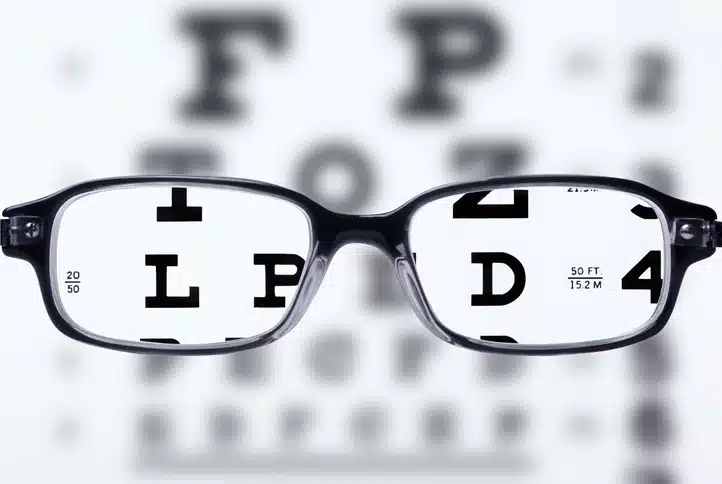 If you choose eyeglasses to correct your astigmatism, your prescription will include two measurements that are specific to astigmatism: cylinder and axis.
- Cylinder (CYL) is a measurement that indicates the lens power for astigmatism.
- Axis is measured in degrees from zero to 180 and refers to the position of astigmatism on the cornea.
If you are nearsighted or farsighted, you will also notice “sphere power” on your eyeglass prescription. The higher the number in your prescription, the more severe the condition. A plus sign indicates farsightedness, and a minus sign indicates nearsightedness.
Contact Lenses
In the past, astigmatism was corrected with rigid contact lenses. Today, there are also soft toric contact lenses that correct astigmatism.
Toric contact lenses offer more comfort for patients with astigmatism and, according to the American Optometric Association, provide a “high degree of accuracy and reproducibility.” Toric lenses are made to bend light in a direction to correct astigmatism.
In more severe cases of astigmatism, an eye doctor may recommend a gas-permeable, rigid contact lens instead of soft toric lenses. Rigid lenses correct astigmatism by creating a spherical surface on the surface of the eye.
A third option is Orthokeratology (Ortho-K) treatment. Patients wear Ortho-K rigid lenses for a specified period to reshape the curvature of their corneas. The correction will occur as long as treatment is ongoing. If treatment is discontinued, astigmatism will recur.
Can LASIK Fix Astigmatism?
Yes, laser surgery can fully correct astigmatism and reduce or even eliminate the need for prescription lenses in most cases. However, the likelihood of a follow-up LASIK procedure increases with higher amounts of astigmatism.
New LASIK options are available for individuals with higher levels of astigmatism and myopia. Wavefront-Guided LASIK (WFG) uses an excimer laser that can normalize complex curvatures and irregularities on the cornea. The American Academy of Ophthalmology states that laser ablation results in improved outcomes, including better night vision and fewer visual symptoms of astigmatism.
Femtosecond LASIK makes use of a femtosecond (FS) laser that creates incisions at a specific, pre-programmed depth in the cornea to correct refractive errors. The predictability of the procedure can provide outstanding results.
LASIK Alternatives
For patients who are not ideal LASIK candidates, Vantage Eye Center offers proven alternatives:
Refractive Lens Exchange (RLE)
RLE replaces the eye’s natural lens with an advanced intraocular lens to correct vision and astigmatism. This option is often recommended for patients over 40 or those with early lens changes.
Advanced Surface Ablation (ASA)
ASA is a laser vision correction procedure that reshapes the cornea without creating a flap. It may be appropriate for patients with thinner corneas or specific corneal considerations.
Your Vantage eye doctor will help determine whether LASIK, RLE, ASA, or another approach best aligns with your vision needs.
Is LASIK or Another Procedure Right for You?
Choosing the proper astigmatism treatment depends on several factors, including corneal thickness, prescription strength, eye health, and lifestyle goals. Some patients may require more than one procedure over time to achieve optimal vision.
The best next step is a LASIK evaluation with an experienced eye care team. If you’re considering vision correction for astigmatism, connect with the specialists at Vantage Eye Center. Our doctors will guide you through your options and help you determine the safest and most effective course of action. Schedule a FREE consultation to learn if you may be a candidate.