Ocular Hypertension: Causes, Risks, and How to Reduce High Eye Pressure
What Is Ocular Hypertension
High eye pressure, also known as ocular hypertension, can quietly affect your vision health—much like high blood pressure can impact the heart. While ocular hypertension doesn’t always cause immediate symptoms, leaving it unmanaged increases the risk of developing glaucoma, one of the leading causes of irreversible vision loss.
Ocular hypertensionrefers to the condition where the fluid pressure inside the eye exceeds the normal range, while the optic nerve and visual field still test normal. Eye pressure rises when the eye makes aqueous fluid faster than it can drain. Left untreated, some patients progress to glaucoma, which can permanently affect vision. Regular eye exams and pressure checks help catch risk early.
The pressure inside your eye is called intraocular pressure (IOP). Normal IOP typically ranges from 10–20 mmHg (millimeters of mercury). Readings above that range are considered elevated and may lead to damage over time if not controlled.
The Connection Between High Eye Pressure and Glaucoma
Ocular hypertension doesn’t automatically mean you have glaucoma, but it’s a major risk factor.
Glaucoma develops when high eye pressure damages the optic nerve, causing gradual and irreversible vision loss. The most common form, open-angle glaucoma, progresses slowly and silently. Over time, peripheral vision begins to narrow, and you would not notice any vision loss until it’s significant.
What Causes High Eye Pressure
Imbalance in Fluid Dynamics
The ciliary body produces aqueous fluid. The trabecular meshwork and uveoscleral pathway drain it. If outflow is reduced or inflow is increased, pressure rises
Age and Systemic Health
Age, hypertension, and metabolic conditions like diabetes can contribute to pressure irregularities. As we age, drainage structures naturally stiffen, making it harder for fluid to exit the eye.
Steroid Response
Topical, inhaled, injected, or oral steroids can raise pressure in steroid responders.
Corneal Thickness and Structure
People with thin or unusually rigid corneas often have less accurate IOP readings and may be at greater risk of pressure-related optic nerve damage.
Medications and Lifestyle Factors
Some medications influence pressure. Poor sleep, heavy caffeine intake, and intermittent Valsalva-type strain can transiently raise measurements.
How We Diagnose Ocular Hypertension
Ocular hypertension is usually painless with no signs or blur of vision loss until the late stage. Because signs are subtle, a comprehensive eye exam with pressure measurement, optic nerve evaluation, and visual field or OCT testing is essential.
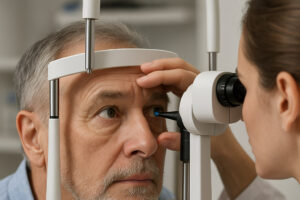
At your visit, your Vantage eye doctor will measure your IOP using tonometry. It’s a quick and painless test to determine how much pressure is inside your eye.
Common types of tonometry include:
Applanation tonometry: Uses a small probe to gently flatten the cornea to measure pressure.
Non-contact tonometry (“puff test”): Uses a puff of air to estimate eye pressure.
iCare tonometry: Uses a handheld device that provides fast, accurate readings.
If your pressure readings are high, your doctor may perform additional imaging to evaluate optic nerve health, corneal thickness, and visual field performance. These help determine whether glaucoma damage has begun or if you’re simply at risk.
How To Reduce Eye Pressure
Lifestyle and Supportive Steps
Keep follow-up appointments and take prescribed therapy on schedule
Use artificial tears if dryness or preservatives affect drop tolerance
Manage caffeine intake and avoid smoking
Maintain regular exercise as advised by your doctor
Discuss any steroid use with your eye care team
Prescription Eye Drops
Eye drops are the first line of defense against high IOP. They work by either reducing fluid production or improving drainage. Common classes include prostaglandin analogs, beta-blockers, and carbonic anhydrase inhibitors. In some cases, oral medications are also prescribed to complement topical treatments.
Laser Treatment
Selective Laser Trabeculoplasty improves outflow through the trabecular meshwork and can be used as initial therapy or as a drop-reducing option
Surgery When Needed
When pressure targets are not met with drops or laser, your surgeon may recommend an operative approach that fits your anatomy and goals. Options include:
Minimally invasive glaucoma surgery, such as trabecular microbypass stents, goniotomy, or trabeculotomy performed through tiny openings inside the eye
Filtering surgery, such as trabeculectomy, to create a new drainage route
Glaucoma drainage devices that channel fluid to a plate reservoir for long-term control
Setting Your Target Pressure
Your doctor will set a personalized target pressure based on your baseline readings, corneal thickness, optic nerve appearance, age, and overall risk. We adjust the plan over time to keep you at or below target with the fewest side effects.
Why Choose Vantage Eye Center
At Vantage Eye Center, serving patients in Monterey, Salinas, and across California’s Central Coast, our glaucoma and cataract specialists use the latest diagnostic and treatment technologies to help patients manage eye pressure safely and effectively. You’ll receive a clear explanation of findings, a stepwise plan that fits your routine, and consistent monitoring with modern imaging. Our team coordinates with your primary care provider as needed and prioritizes comfort, safety, and long-term vision protection.
Ready for a Change
Ocular hypertension is manageable. Understanding what causes high eye pressure and how to reduce it helps protect your vision for the long term. If you have risk factors or elevated readings, request a comprehensive evaluation at Vantage Eye Center today.
Related Posts
We’re here when you’re ready.
We make scheduling easy! Schedule online or call our office (831) 375-9876
To provide the best experiences, we use technologies like cookies to store and/or access device information. Consenting to these technologies will allow us to process data such as browsing behavior or unique IDs on this site. Not consenting or withdrawing consent, may adversely affect certain features and functions.
Functional
Always active
The technical storage or access is strictly necessary for the legitimate purpose of enabling the use of a specific service explicitly requested by the subscriber or user, or for the sole purpose of carrying out the transmission of a communication over an electronic communications network.
Preferences
The technical storage or access is necessary for the legitimate purpose of storing preferences that are not requested by the subscriber or user.
Statistics
The technical storage or access that is used exclusively for statistical purposes.The technical storage or access that is used exclusively for anonymous statistical purposes. Without a subpoena, voluntary compliance on the part of your Internet Service Provider, or additional records from a third party, information stored or retrieved for this purpose alone cannot usually be used to identify you.
Marketing
The technical storage or access is required to create user profiles to send advertising, or to track the user on a website or across several websites for similar marketing purposes.